zkvm
Ethereum Block Validation inside Jolt
14 August 2026
Measuring an Ethereum block on Jolt's zkVM, and the impact of acceleration.
Jolt is a zero-knowledge virtual machine from a16z crypto. It has a striking design - no hand-written circuit per instruction, just lookups - and a lot of attention. What it did not have, until now, was any evidence about whether it can execute and prove Ethereum blocks.
So I built the integration and measured it. This post walks through what came out, in order, starting from what the problem even is.
What is being measured, and why
Ethereum has a scaling idea that goes like this. Today, every node re-executes every block to know it’s valid. That’s a lot of duplicated work. Instead: have one machine execute the block and produce a cryptographic proof that it did so correctly. Everyone else checks the proof, which takes milliseconds.
For this to work you need block validation to be a self-contained computation - no database, no network. That’s stateless validation: you hand the validator a block plus a witness containing exactly the pieces of Ethereum’s state that this block touches, along with proofs those pieces are real. The validator checks everything against the parent block’s state root. Self-contained, so it can run inside a zkVM.
The Ethereum Foundation maintains the reference version of this - a Rust program
called stateless-validator-reth - plus a harness so different zkVMs can be
measured on the same program and the same test blocks, instead of each vendor
publishing its own benchmark. SP1, from Succinct, already plugged into it. Jolt
did not.
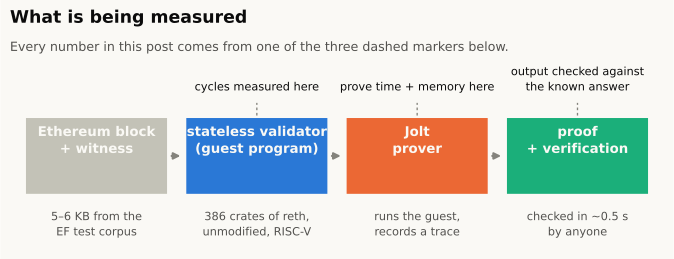
Two terms you need for the rest of this post:
Cycles. When the prover runs your program, it records every step in a big table called a trace. One row per step. “Cycles” means rows in that table, and it’s the thing proving cost scales with. Fewer cycles, cheaper proof.
The guest. The program being proven, compiled to RISC-V. Here it’s the EF’s stateless validator, unmodified.
Getting It to Run
The first question was simply whether the EF’s validator could be made to work on
Jolt at all. It’s production Rust - reth, Ethereum’s second-most used client -
compiled to a bare-metal RISC-V target with no operating system, no allocator
guarantees, and no standard library.
It worked, with one fix.
The one fix is a nice illustration of how these things break. Somewhere deep in
reth, hashing a block header caches the result in a OnceCell. OnceCell needs
a lock. Locks on bare metal need a critical-section implementation, and nobody
had written one for Jolt. So the link failed on a missing symbol with an
unhelpful name.
The fix is five lines and does nothing: a zkVM guest is single-threaded and can’t be interrupted, so “acquire the lock” is a no-op. But you have to know that. It now lives in the platform crate so the next person doesn’t lose an afternoon.
The result is a 2.1 MB RISC-V binary that proves real Ethereum test blocks and produces output byte-identical to the answer the test fixture says is correct.
ecrecover also had to be implemented. Ethereum’s ecrecover precompile - the
thing that turns a signature into the address that signed it - needs a recovery
operation, and Jolt ships signature verification but not recovery.
Inlines and Precompiles
Ethereum blocks are full of cryptography - hashing, signature checks. Doing that in plain software inside a zkVM is expensive, so zkVMs offer accelerated versions. The EF’s harness has a standard way for a guest to call them.
So: run the same block twice, once with software crypto, once with Jolt’s accelerated versions. How much faster?
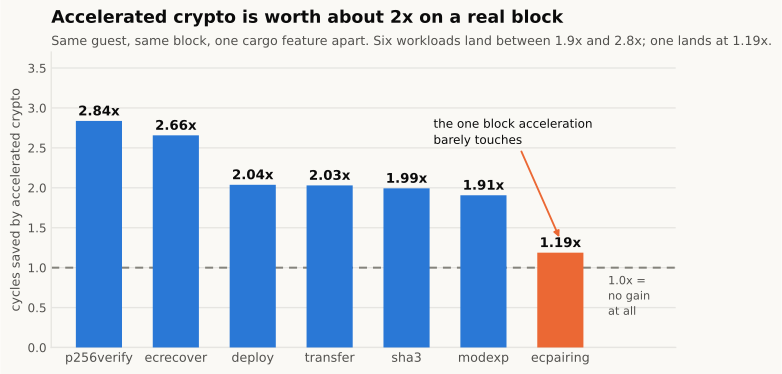
About 2x. Best case 2.84x, worst case 1.19x.
If you were expecting 10x or 50x, that expectation is worth examining, because it’s common and it comes from a real difference between how Jolt and SP1 work.
In SP1, an accelerated operation is a precompile: the main program makes one call, and the actual hashing happens in a separate piece of machinery with its own circuit. The work leaves the main trace.
In Jolt, an accelerated operation is an inline: it expands into a sequence of special instructions that run in the same trace as everything else. The work gets cheaper, but it doesn’t leave.
Concretely, I measured Jolt’s keccak hash at 24.5 cycles per byte accelerated against 60.5 in software. Of the ~3,334 cycles each hash permutation costs, about 75 are ordinary RISC-V instructions and about 3,259 are these expanded special instructions. They’re rows in the table just like everything else (this is Jolt’s documented design - JoltBook says inlines “remain fully integrated within the main Jolt zkVM execution model”).
Discrepancies:
- Jolt’s benchmark page reports keccak at 26 cycles/byte accelerated against 78 in software, for 3.01x.
- The accelerated number here matches theirs closely: 24.5 vs 26.
- The software baseline does not: 60.5 vs 78, a 29% gap.
- That gap is the entire difference between 2.47x here and their 3.01x. Could be a library version, could be the target, could be the measurement - upstream has been asked.
- Separately, Jolt’s API reference page for the same function claims “~10-100x reduction in VM cycles,” more than an order of magnitude off Jolt’s own benchmark, and probably where the inflated expectation comes from.
A third of a small block isn’t the EVM at all
If someone asks you where the time goes in Ethereum block validation, the obvious answer is “executing transactions.” The guest was instrumented to find this out.
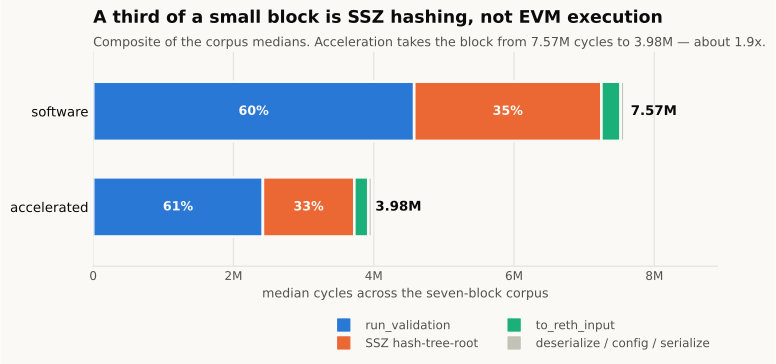
Transaction execution is about 60%. But a third of the block is one hashing step - computing a Merkle root over the payload, pure SHA-256, before any transaction runs.
Two things follow. First, if you’re optimising a stateless validator guest and you only looked at the EVM, you missed a third of the work. Second, a caveat on my own numbers: this share is inflated by the fact that public test blocks are tiny. That hashing step scales with the block header, not with the number of transactions, so on a real mainnet block with hundreds of transactions it would be a much smaller slice.
The impact of unaccelerated bn254
Look back at the speedup chart. Six blocks get roughly 2x. One block -
ecpairing - gets 1.19x. It is also the most expensive block in the set by a
wide margin: 20.4M cycles, against 3.4M for a plain transfer.
The reason is a missing feature. That block spends nearly all its time on bn254 pairings, the elliptic-curve cryptography behind most of Ethereum’s zero-knowledge and rollup infrastructure, and Jolt ships no accelerated version of it. With nothing to call, the pairing runs in plain software exactly as it did before. The 1.19x that remains is the block’s hashing getting faster around a pairing operation that acceleration never touched.
Two separate measurements say the same thing:
- The speedup is flat. 1.19x, where every other block gets ~2x.
- The trace shows almost nothing was accelerated. Jolt’s accelerated operations expand into special “virtual” instructions, so the share of the trace that is virtual tells you how much of the work reached an accelerated path. Turning acceleration on moves a normal block from about a fifth virtual to about two thirds. The pairing block goes from 10% to 14% - it barely moves. That ratio is a cheap diagnostic for “is this workload actually accelerated,” runnable on a workload nobody has characterised by hand.
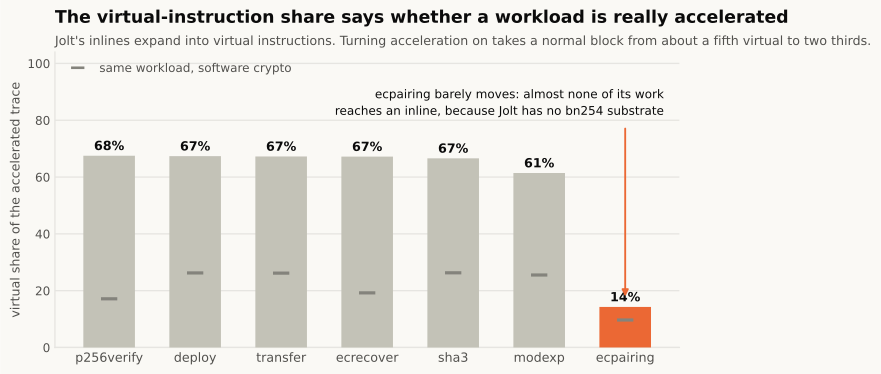
SP1 ships a bn254 precompile, so this is a missing feature rather than a cost inherent to proving pairings. If you want one thing to build for Jolt’s Ethereum story, it’s bn254. Nothing else I measured comes close.
Proving cost is a staircase
Everything above has been about removing cycles. This section is about when that is worth doing, and the answer is not “always.”
Jolt’s prover is not sized for your trace. It rounds the trace length up to the next power of two and builds a prover for that. A 3.3-million-row trace and a 4.1-million-row trace both round up to 4,194,304 rows, so both get the same prover and both cost the same to run - the extra 800,000 rows are free. Cross into the next power of two and the cost roughly doubles.
So the cost curve is a staircase: flat between two powers of two, and a jump at each one. Which means the question “how many cycles did I save?” is the wrong question. The right one is “did I land on a lower step?”
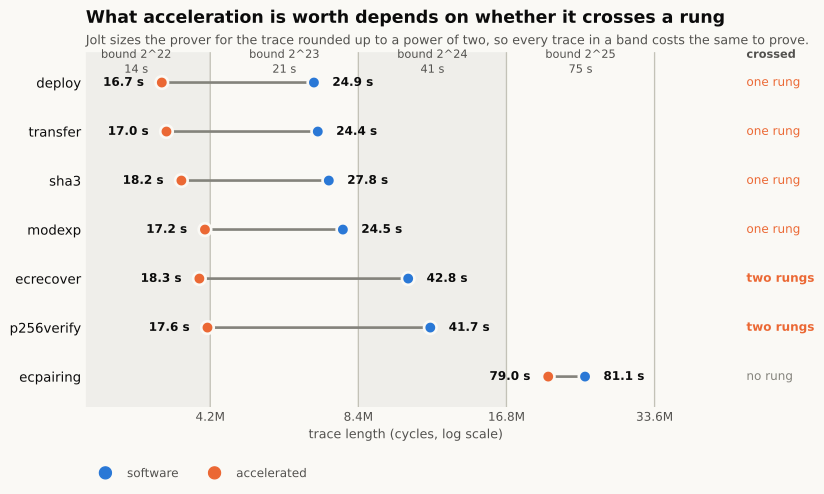
The same optimisation, applied to two different blocks, gives opposite answers:
ecrecover- acceleration removed 62% of the cycles, enough to drop two steps. Proving went from 42.8 s to 18.3 s: 2.3x cheaper.ecpairing- acceleration removed 16% of the cycles, not enough to drop even one. Proving went from 81.1 s to 79.0 s, which is inside the run-to-run noise: the saving bought nothing at all.
Here is the same effect from the other direction, and it looks like a broken measurement until you know about the steps. Two blocks both landed on the 2^24 step. The one with 11% more cycles proved 1.1 seconds faster. Nothing is wrong with either number - both traces rounded up to the same size, so the prover did identical work twice, and what’s left is noise on a fixed cost.
That holds across the whole campaign. Grouping all fourteen runs by the step they landed on, and asking how much the cycle counts varied within each group against how much the proving times varied:
| step | cycle counts varied by | proving times varied by |
|---|---|---|
| 2^22 (6 runs) | 24% | 10% |
| 2^23 (4 runs) | 15% | 14% |
| 2^24 (2 runs) | 11% | 3% |
| 2^25 (2 runs) | 19% | 3% |
Inside a step, cycles barely predict anything. Across steps, they’re the only thing that predicts anything.
The practical version: before optimising a Jolt guest, work out which step you’re on and how far you are from its edge. A 10% saving is worth nothing unless it crosses. A 50% saving might be worth 2x or might be worth nothing, depending entirely on where you started.
This also puts a price on the bn254 gap from the previous section. An accelerated bn254 path that dropped the pairing block two steps would take it from 79 s to the 24–28 s the other blocks cost down there - about 3x - where today’s acceleration moves it nowhere.
Time and Memory
This was tested on a MacBook - Apple M3 Max, 14 cores, 36 GiB of RAM. Every prove and verify number below comes from that one machine.
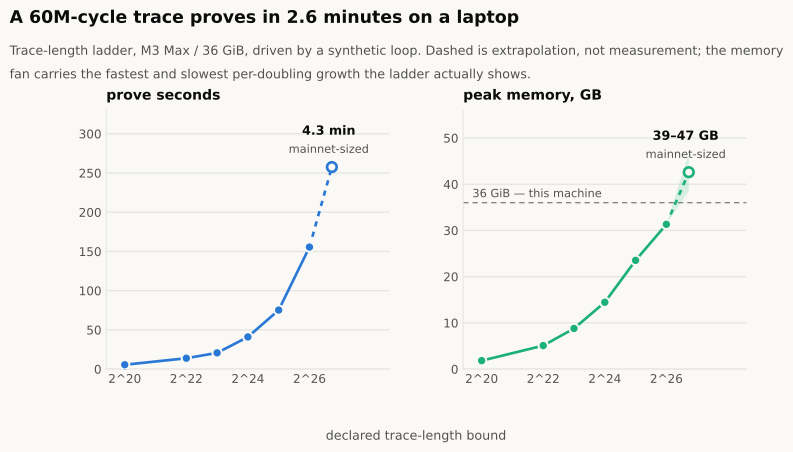
A 60-million-cycle trace proves in 2.6 minutes, peaking at 31.3 GB of the 36 GB available. An earlier draft of my report stated confidently that this would not fit. It fits. I found that out by running it instead of extrapolating it, which turns out to be the moral of the last section as well.
Verification stays at about 0.07 seconds across the whole 64x range. That’s the whole point of the exercise: minutes to prove, milliseconds to check.
Extrapolating to a mainnet-sized block (~100 million cycles) gives roughly 4.3 minutes of proving. Memory is less certain - growth is 1.73x per doubling early in the ladder but only 1.33x at the top, and carrying those forward gives 39 GB and 47 GB respectively. So: an ordinary server, not a cluster. I’ve flagged that memory range as the thing I’d most like someone with more Jolt experience to check.
Jolt vs SP1
SP1 is the zkVM already plugged into the EF’s harness, so it’s the obvious reference point. I ran the same seven blocks through it - same guest source, same fixtures, same machine.
The result worth reporting is a correctness one. Both provers produce output byte-identical to the fixture’s canonical answer, on all seven blocks. That is the cross-check in its strongest form: not two implementations agreeing with each other, but both agreeing with the reference the EEST fixture carries.
I am deliberately not publishing a cycle-count comparison. The two numbers don’t measure the same thing - Jolt’s is trace rows, and its inlines expand into that trace; SP1’s is instructions, and its precompiles run in separate machinery the number never shows. Dividing one by the other produces a figure that looks like a verdict and isn’t. Some of it would be a real architectural difference and some of it bookkeeping, and cycle counts alone cannot separate the two.
What a real comparison needs is numbers in neither system’s private units: prove time, verify time, proof size, peak memory. All four are wall-clock seconds and bytes, all four are directly comparable between any two provers, and I have all four for Jolt and none for SP1 - I only ever ran SP1 in execute mode. That’s a gap in the study, not a limitation of the method, and it’s the next thing I’ll fix.
When I do, I expect it to be more interesting than a single winner. Jolt should look good on CPU proving speed. SP1 should look good on verification and proof size, because it compresses its proof recursively where Jolt at this version verifies the raw one - and it’s a big raw one: Jolt’s verifier needs 98 MB of program-specific setup where SP1’s needs 32 bytes. Each winning something for a legible reason beats a scoreboard.
What’s next
In order of how much they’d move the numbers:
- A bn254 accelerated path. Three independent measurements say it’s the biggest gap, and the staircase says it’s worth about 3x on pairing blocks.
- The SP1 prover comparison - prove time, verify time, proof size, memory. The missing half of the SP1 section above.
- Jolt’s refactored prover. Every number here comes from the older prover, because that’s what the guest macro reaches at this commit. Expect these to move.
- A real mainnet block. Everything here is 5–6 KB witnesses; the scaling number is an extrapolation across two orders of magnitude and should be treated as a hypothesis.
- Joining ethproofs as a proving cluster.
Code, data and the full technical report: github.com/andreacarotti9/jolt-eth
Not affiliated with a16z, Succinct or the Ethereum Foundation. Numbers are tied to
pinned upstream commits and go stale as those projects move; Jolt is 915faf4
(August 2026), and every proving number comes from jolt-prover-legacy.